 Acrossprotocol
 relayers
How do Across relayers fill an intent? Operators use their own capital to provide the destination assets that a user's order requires. The documented V3 bot identifies unfilled deposits across chains and attempts fills when its token balances permit.
- Operator Software
- Across V3 Relayer, a Node.js application for operating relay infrastructure.
- Minimum V3 Host
- The documented V3 minimums are a 64-bit dual-core CPU at 2+ GHz, 4 GB RAM, and a UNIX-like operating system such as GNU/Linux or macOS.
- Submission Default
-
The V3 bot defaults to
SEND_RELAYS=false, which disables relay transaction submission.
Destination Fills and V3 Repayment
The
/deposit/status
endpoint lets integrations verify whether an intent has filled on the destination chain. The Swap API's
expectedFillTime
estimates destination-fill time in seconds; V3 repayment follows a separate root-bundle process.
V3 root bundles contain three Merkle roots with repayment information for relayers that fulfilled deposits within a given block range. Operators can select their repayment chain, which affects the distribution of liquidity provider fees.
V3 Operator Workflow
-
Configuration
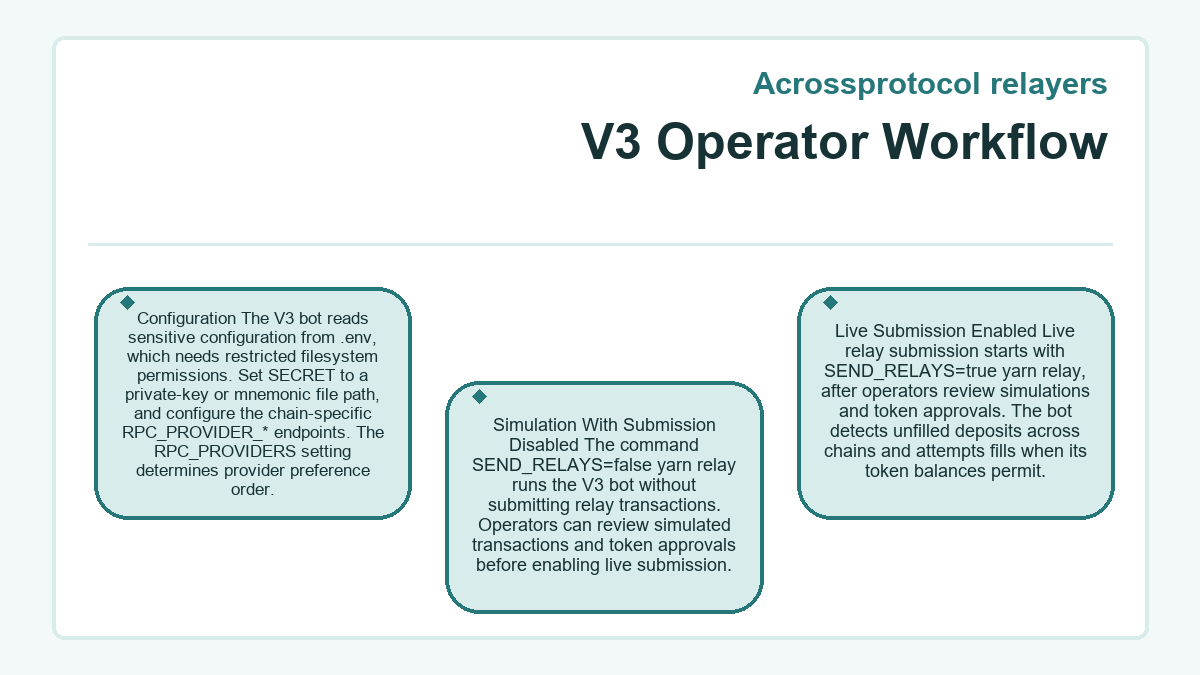
The V3 bot reads sensitive configuration from
.env, which needs restricted filesystem permissions. SetSECRETto a private-key or mnemonic file path, and configure the chain-specificRPC_PROVIDER_*endpoints. TheRPC_PROVIDERSsetting determines provider preference order. -
Simulation With Submission Disabled
The command
SEND_RELAYS=false yarn relayruns the V3 bot without submitting relay transactions. Operators can review simulated transactions and token approvals before enabling live submission. -
Live Submission Enabled
Live relay submission starts with
SEND_RELAYS=true yarn relay, after operators review simulations and token approvals. The bot detects unfilled deposits across chains and attempts fills when its token balances permit.
V3 Inventory and Infrastructure
Automatic rebalancing uses a JSON configuration for target allocation percentages per token and chain. Operators can also configure WETH wrapping and unwrapping thresholds, along with repayment-chain selection.
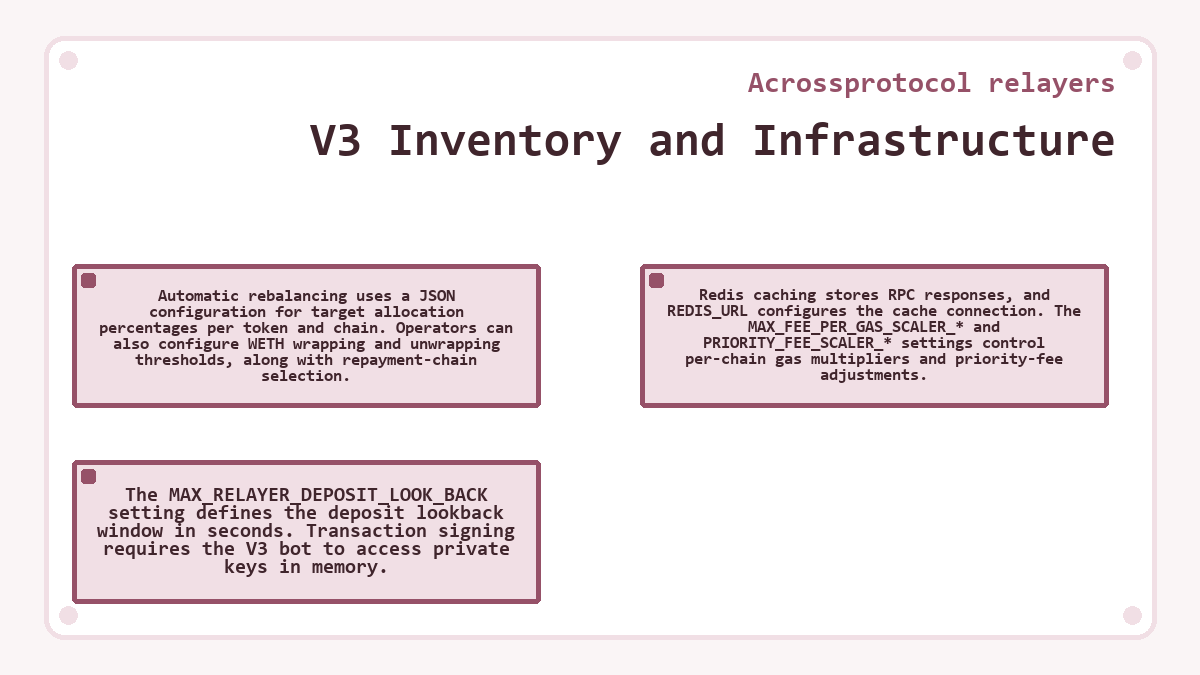
Redis caching stores RPC responses, and
REDIS_URL
configures the cache connection. The
MAX_FEE_PER_GAS_SCALER_*
and
PRIORITY_FEE_SCALER_*
settings control per-chain gas multipliers and priority-fee adjustments. The
MAX_RELAYER_DEPOSIT_LOOK_BACK
setting defines the deposit lookback window in seconds.
Transaction signing requires the V3 bot to access private keys in memory.
V3 Operator Decision Checklist
-
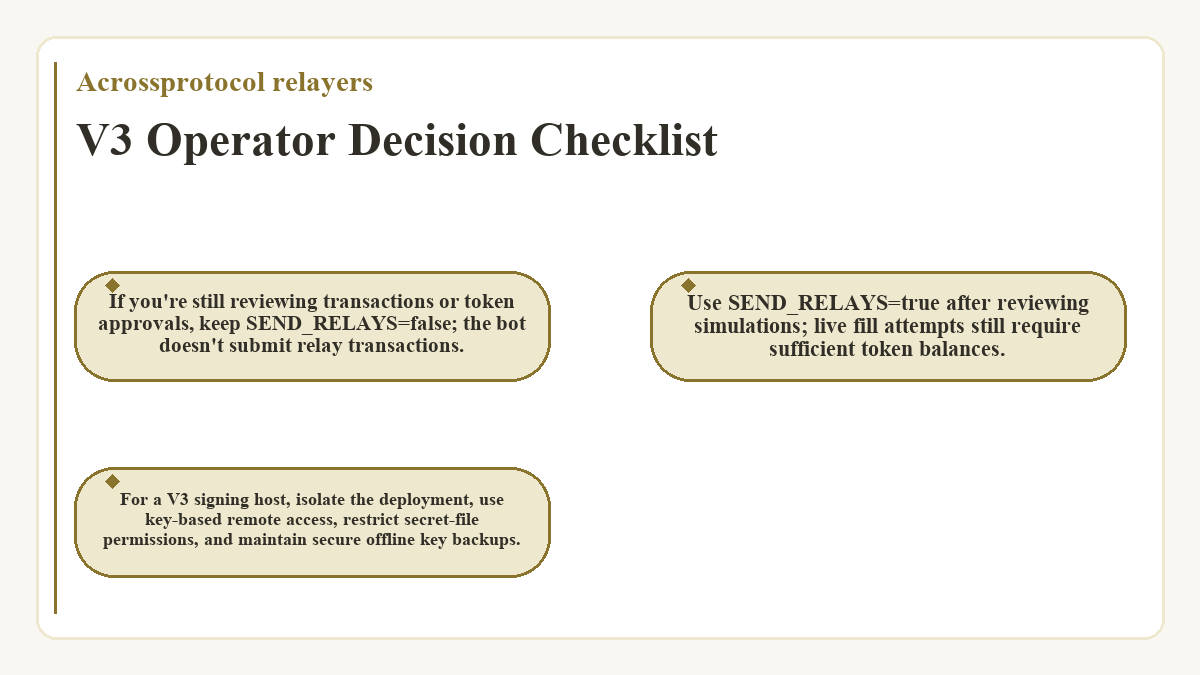
If you're still reviewing transactions or token approvals, keep
SEND_RELAYS=false; the bot doesn't submit relay transactions. -
Use
SEND_RELAYS=trueafter reviewing simulations; live fill attempts still require sufficient token balances. - For a V3 signing host, isolate the deployment, use key-based remote access, restrict secret-file permissions, and maintain secure offline key backups.