 Acrossprotocol
 liquidity pools: Why LP Fees Vary
Why can similar transfers carry different LP fees? Across's pools supply rebalancing capital, with LP fees that reflect utilization, token, route, and repayment location.
- Deposit network
- Liquidity providers deposit assets on Ethereum mainnet for Across's HubPool-backed settlement model.
- Capital uses
- Pool capital supports rebalancing across SpokePools and backup fulfillment when no relayer fills a deposit.
- Zero LP fee
- The LP fee is zero when the relayer takes repayment on the user's deposit chain. Relayer fees can still apply.
- Withdrawal availability
- High demand may temporarily prevent withdrawals while pool capital supports rebalancing and fills.
Pool Capital and Relayer Capital
Relayers front their own tokens on the destination chain, enabling fills before their later reimbursement. Liquidity providers supply shared capital that lets the HubPool rebalance funds across SpokePools.
Relayers can request repayment on any Across-supported chain, including one other than the deposit chain. Pool liquidity helps the HubPool honor those choices and can fund backup fulfillment for unfilled deposits.
Utilization-Based LP Pricing
Pool utilization measures how much of the available liquidity the pool is using. Across's pricing curve increases the rate as utilization rises, then steepens beyond its configured kink threshold.
The base rate, slopes, and kink threshold vary by token and route. Different routes can therefore carry different LP fees even when the transferred token matches.
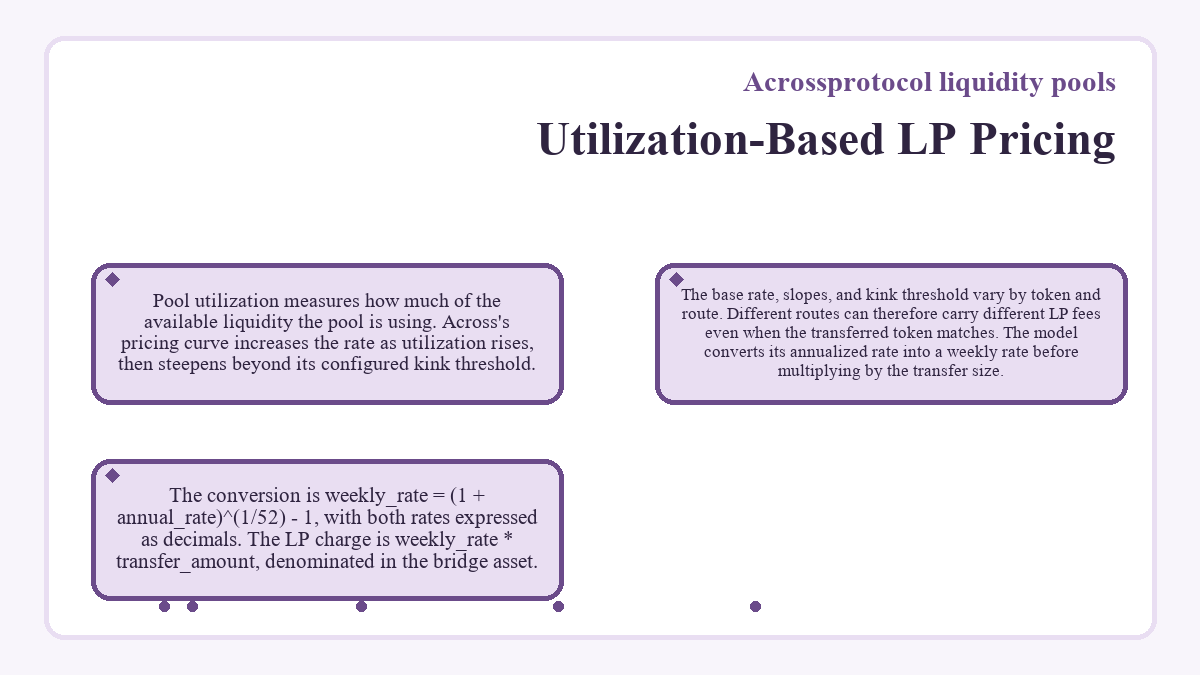
The model converts its annualized rate into a weekly rate before multiplying by the transfer size. The conversion is
weekly_rate = (1 + annual_rate)^(1/52) - 1
, with both rates expressed as decimals. The LP charge is
weekly_rate * transfer_amount
, denominated in the bridge asset.
Repayment Location and Other Fees
Origin-chain repayment makes the LP fee zero because that arrangement doesn't require crosschain rebalancing. When the relayer takes repayment on another chain, the applicable utilization-based LP fee applies instead.
Relayer fees cover destination gas, capital opportunity cost, and risks such as reorganizations and settlement delays. For EVM or Solana destinations, integrators may also add an app fee charged in the output token. That fee goes to the integrator's designated recipient, separately from the LP and relayer components.
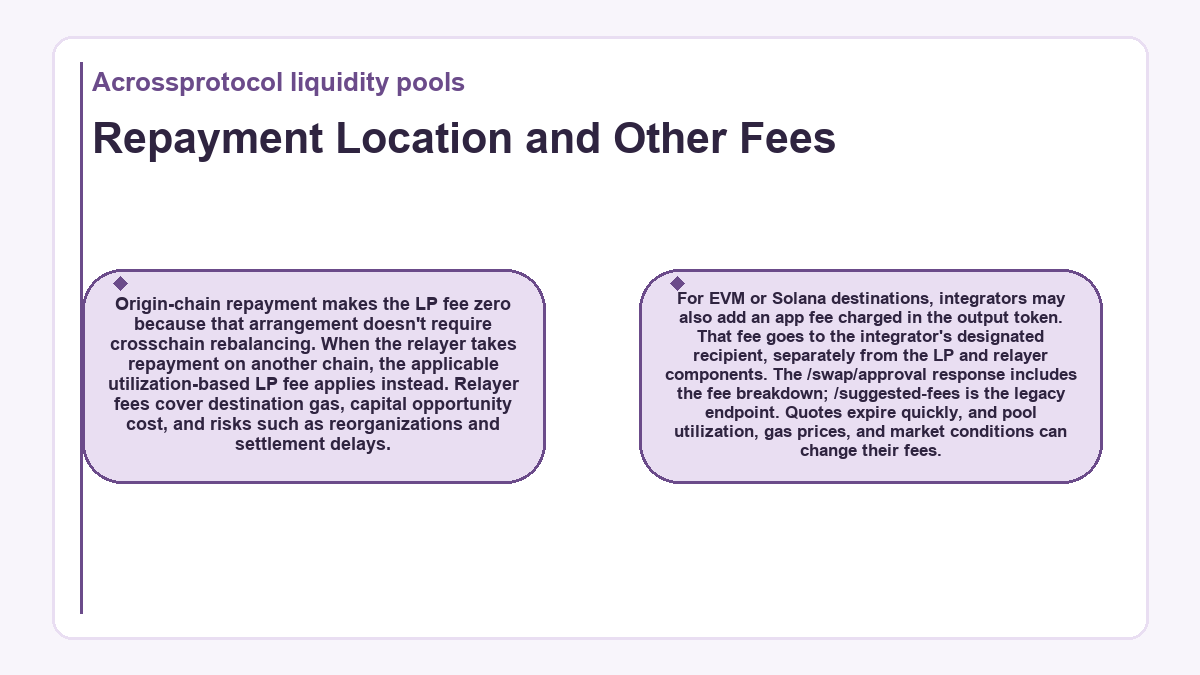
The
/swap/approval
response includes the fee breakdown;
/suggested-fees
is the legacy endpoint. Quotes expire quickly, and pool utilization, gas prices, and market conditions can change their fees.
Hypothetical Origin-Chain Repayment
A zero-LP-fee requirement can still allow a separate relayer charge.
Assume these hypothetical terms: a 947 USDC deposit on Arbitrum, delivery on Base, and relayer repayment on Arbitrum. The hypothetical relayer fee is 1.36 USDC, with no swap legs or app fee.
The matching deposit and repayment chains make the LP component zero under the documented exception. The destination amount is
947 - 0 - 1.36 = 945.64
USDC, giving a bridge fee of 1.36 USDC.
The calculation excludes origin-chain transaction gas, which would add to the user's total transaction cost. Repayment on another chain would remove the exemption and add that route's applicable LP charge.
V3 Settlement and LP Risks
Across's documented V3 model reimburses relayers through bundles, separately from their earlier destination fills. A whitelisted dataworker aggregates fills and rebalancing instructions into bundle proposals for the HubPool on Ethereum.
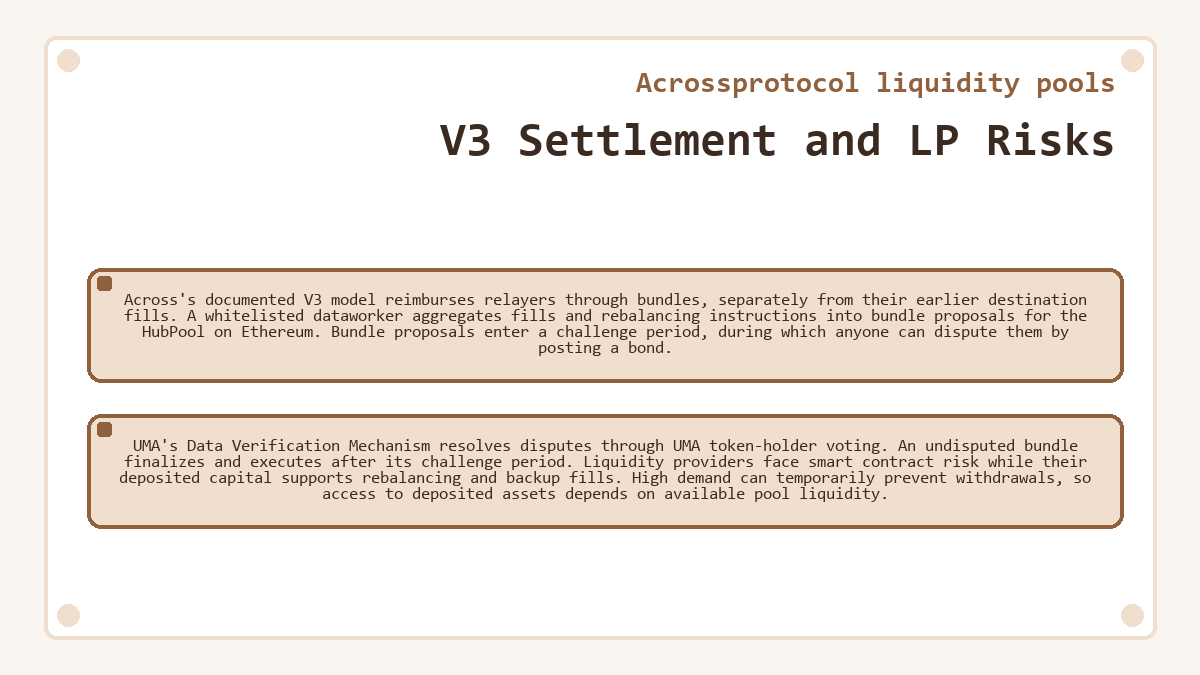
Bundle proposals enter a challenge period, during which anyone can dispute them by posting a bond. UMA's Data Verification Mechanism resolves disputes through UMA token-holder voting. An undisputed bundle finalizes and executes after its challenge period.
Liquidity providers face smart contract risk while their deposited capital supports rebalancing and backup fills. High demand can temporarily prevent withdrawals, so access to deposited assets depends on available pool liquidity.